
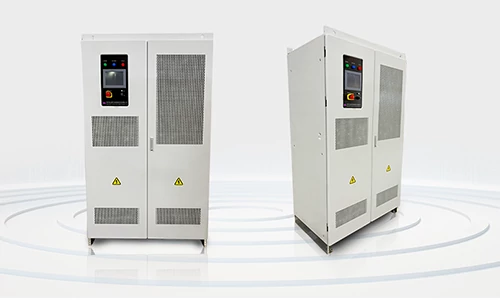
The power storage converter (PCS) is a vital device that plays a core role in the battery system. It is responsible for managing the battery charging and discharging process and realizing the AC-DC conversion of electrical energy. In the absence of grid connection, the PCS can directly provide power to the AC load. Its structure mainly includes a DC/AC bidirectional converter and a control unit. Through these components, the PCS realizes fine regulation of the active and reactive power of the grid.
Working principle
The working principle of PCS is based on the converter technology of four-quadrant operation, which can realize two-way conversion of electric energy. According to the microgrid monitoring instructions, it adopts constant power or constant current control strategy to charge or discharge the battery, and stabilize the output of wind power, solar power and other fluctuating power sources. In addition, PCS ensures precise regulation of output voltage, frequency, active and reactive power through double closed-loop control and SPWM pulse modulation method.
The hardware components of PCS include IGBT, PCB board, wires and cables, etc. These components jointly support its functions of smoothing power fluctuations, information exchange and protection. The performance of PCS directly affects the quality and dynamic characteristics of the output power, and also has a significant impact on the service life of the battery.
Development Trend
In electrochemical energy storage systems, PCS plays a crucial role. It interacts closely with the energy management system (EMS) and battery management system (BMS) to jointly ensure the safe and efficient operation of the battery system. With the continuous development of technology, improving the reliability of PCS machines has become an important direction in product design and manufacturing. At the same time, in terms of operation and maintenance management, it is also particularly important to develop a complete PCS complete machine testing system and testing technology to support business needs such as PCS arrival sampling inspection, operation and maintenance, and maintenance.
Functional features
The functional features of PCS include comprehensive protection functions, such as over-under voltage, overload, over-current, short circuit, over-temperature and other protection mechanisms. In addition, PCS also has islanding detection capabilities and can switch modes when necessary. In terms of communication, PCS can communicate with superior control systems and energy switches to achieve real-time interaction of data. In terms of control strategy, PCS supports grid-off-grid smooth switching control to ensure the continuity and stability of power supply.
Working mode
PCS has multiple working modes to adapt to different application scenarios. In the grid-connected mode, PCS realizes the two-way flow of energy between the energy storage battery and the grid, smoothing the output of the volatile power supply. In off-grid mode, PCS can provide stable AC power to local loads. In hybrid mode, PCS can flexibly switch between grid-connected and off-grid modes to ensure continuity and reliability of power supply.


